Key Takeaways
- Generative, predictive, and platform-native AI each serve distinct roles across the eight stages of an advertising campaign workflow.
- AI-generated images lack guaranteed copyright protection; the U.S. Copyright Office excludes purely AI-generated material from copyright claims.
- Provider commercial-use terms vary sharply between Adobe Firefly, Midjourney, and Getty, and none constitute complete legal rights clearance for a campaign.
- Meta and Google require advertiser disclosure for specified synthetic or altered media only in defined ad categories, not all AI creative broadly.
- Automated bidding systems like Google Smart Bidding optimize toward the advertiser-selected objective, not unstated business outcomes, requiring active budget monitoring.
- Brand consistency is a material operational risk in generative creative, requiring human review before any AI asset is trafficked or published.
- Data-driven attribution in Google Analytics 4 distributes credit across touchpoints using a model, not randomized causal proof of a channel's true contribution.
What Is AI in Advertising? (And the AI Types That Actually Matter)
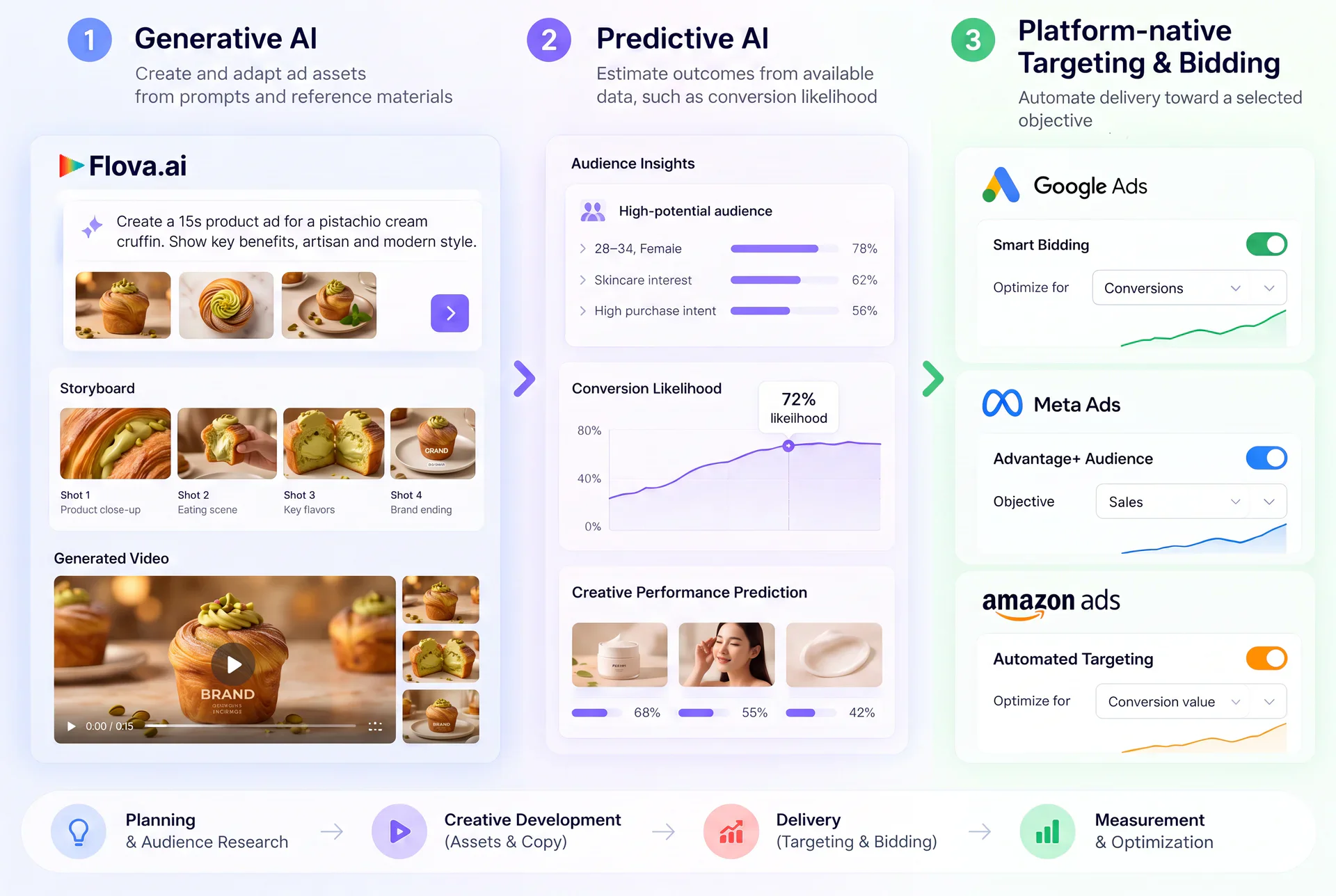
AI in advertising can support planning, creative development, audience selection, delivery, and measurement across a campaign lifecycle. Google Ads, Meta Ads, and Amazon Ads each document AI- or machine-learning-powered advertising capabilities, although their features, availability, and advertiser controls vary by product.
For practical workflow planning, three functional labels are useful:
- Generative AI can help create or adapt creative assets such as ad copy, images, video scripts, and landing-page variants from prompts and reference materials.
- Predictive AI can estimate outcomes from available data, such as conversion likelihood or propensity, where a platform or model supports the use case.
- Platform-native targeting and bidding systems can automate delivery toward a selected objective; for example, Google Smart Bidding uses Google AI to optimize bids for conversions or conversion value at auction time.
These labels are a practical workflow guide, not a universal taxonomy. Start with the capability that fits the decision at hand, and validate results rather than assume that every campaign needs all three. Generative tools are relevant when briefs become assets, predictive models can inform planning or measurement, and platform delivery systems can make repeated auction-time decisions toward the objective an advertiser selects.
AI Use Cases Across the Advertising Workflow (Ideation to Measurement)
AI can support eight stages of a campaign workflow, from audience research through post-campaign attribution. The applicable AI type, platform controls, and review requirements differ by stage.
1. Audience Research & Targeting
Predictive machine learning can help prioritize advertising audiences when the selected ad platform supports it. Where available, a Meta lookalike audience can reach new people who share characteristics with a source audience. Availability and permitted use depend on factors including campaign category, location, and platform policy. Test predictive targeting against manual segmentation with a randomized holdout when the decision requires an estimate of incremental conversion lift.
The AI type is predictive ML. The guardrail is ongoing monitoring and periodic proxy-discrimination review at a risk-based frequency, rather than reliance on removing protected attributes alone. NIST's AI Risk Management Framework supports ongoing monitoring and periodic review, while platform restrictions may limit audience tools for sensitive categories.
2. Creative Ideation
Creative ideation can use large language models to draft structured creative briefs, headline directions, and concept variants from a campaign objective. Teams can explore different angles, such as emotional or rational, scarcity or aspiration, and product-led or lifestyle-led concepts. The AI type is a generative LLM. The guardrail is to treat each output as a draft for human creative review, not as a final brief.
Flova's AI video-creation workflow can begin with natural-language direction and reference media, then move through planning and generation steps in one workspace.
3. Creative Generation (Images & Video)
Creative generation tools can help teams develop and iterate image and video concepts using prompts, reference media, and generation settings. A product asset can be adapted into background, lighting, scene, and format variations for different campaign concepts and placements.
Output quality, factual accuracy, cost, and practical usefulness depend on the selected model, input quality, generation settings, and review process. The relevant AI type is a generative image or video model. Before an asset is trafficked, teams should inspect and revise each final asset for product accuracy, intellectual-property concerns, permissions, recognizable people, and fit with the approved creative direction.
Verified product details and human approval remain important because AI cannot reliably infer every hidden detail from a single image. When teams use product photos or other creative references, they should clearly specify which details must remain consistent and review generated variations before using them in a campaign.
4. Copywriting & Ad Variations
Ad copywriting tools can draft headline, description, and call-to-action variants for different funnel stages or approved audiences. A core message can be adapted for tone and length, but teams should assess every version for brand fit, accuracy, substantiation, and applicable policy requirements. The AI type is a generative LLM. The guardrail is a documented brand-voice and claims-review process. NIST identifies harmful bias or homogenization and information-integrity concerns among generative-AI risks.
5. Media Buying & Automated Bidding
Media-buying platforms offer different forms of automated bidding. Google Smart Bidding uses Google AI and machine learning to optimize for conversions or conversion value in every auction. Meta, meanwhile, describes Advantage+ as an AI-powered suite that optimizes campaigns in real time. These provider-described capabilities should not be characterized as reinforcement learning unless the provider specifies that mechanism.
Advertisers should define conversion events, budgets, and bid targets that reflect the business decision, then evaluate results in their own campaigns. The guardrail is to set and monitor appropriate budgets, targets, and business constraints because an automated system optimizes toward the selected objective, not an unstated business outcome.
6. Personalization at Scale
Dynamic creative and platform delivery features can assemble approved variations from supplied creative elements, feeds, and rules. Google's dynamic creative documentation and Meta's dynamic creative documentation describe related tools, but the degree of personalization varies by product, data, consent, and delivery setup. The AI type may involve recommendation, prediction, and rules-based systems. The guardrail is to use data and personalization only within the platform's controls and the campaign's applicable privacy, consent, and targeting requirements.
7. A/B Testing
Multi-armed bandit tests allocate impressions dynamically toward variants that appear to perform better, rather than keeping traffic equally split to a fixed end date. This can reduce expected exposure to less effective variants. It does not itself establish faster statistical significance; adaptive allocation requires inference appropriate to the allocation rule. The AI type is a multi-armed bandit algorithm; some implementations, such as Thompson sampling, are Bayesian.
The guardrail is to define the primary metric and analysis plan before launch, then use an inference method appropriate to adaptive allocation. Research on adaptive experimentation explains the expected-regret objective and its trade-offs.
8. Analytics & Attribution
Campaign analytics can use model-based attribution. Google Analytics 4 uses data-driven attribution by default in its attribution reports. It distributes key-event credit across eligible touchpoints using property data rather than a fixed last-click rule. In contrast, paid-and-organic last click assigns 100% of key-event credit to the last qualifying channel. Data-driven attribution therefore provides a model-based view of credit for eligible touchpoints that would receive no credit under that last-click rule. It is not randomized causal proof of a channel's true contribution.
The guardrail is to validate material attribution decisions with a suitably designed randomized incrementality test when causal measurement is needed. Cadence and design should be set for the decision, traffic, cost, and media-mix changes.
Generative AI for Ad Creative: Producing Images, Video, and Variations at Scale
Generative tools can support creative drafting and variation production. The time, cost, scale, and quality of usable output depend on the tool, inputs, specifications, approvals, and workflow.
A practical workflow has four stages: concept prompting, image or video generation, variation branching, and brand-consistency review. Flova describes a project workflow that moves from prompts or reference media through storyboard, media generation, timeline editing, and export.
How to Create an AI Video Ad with Flova
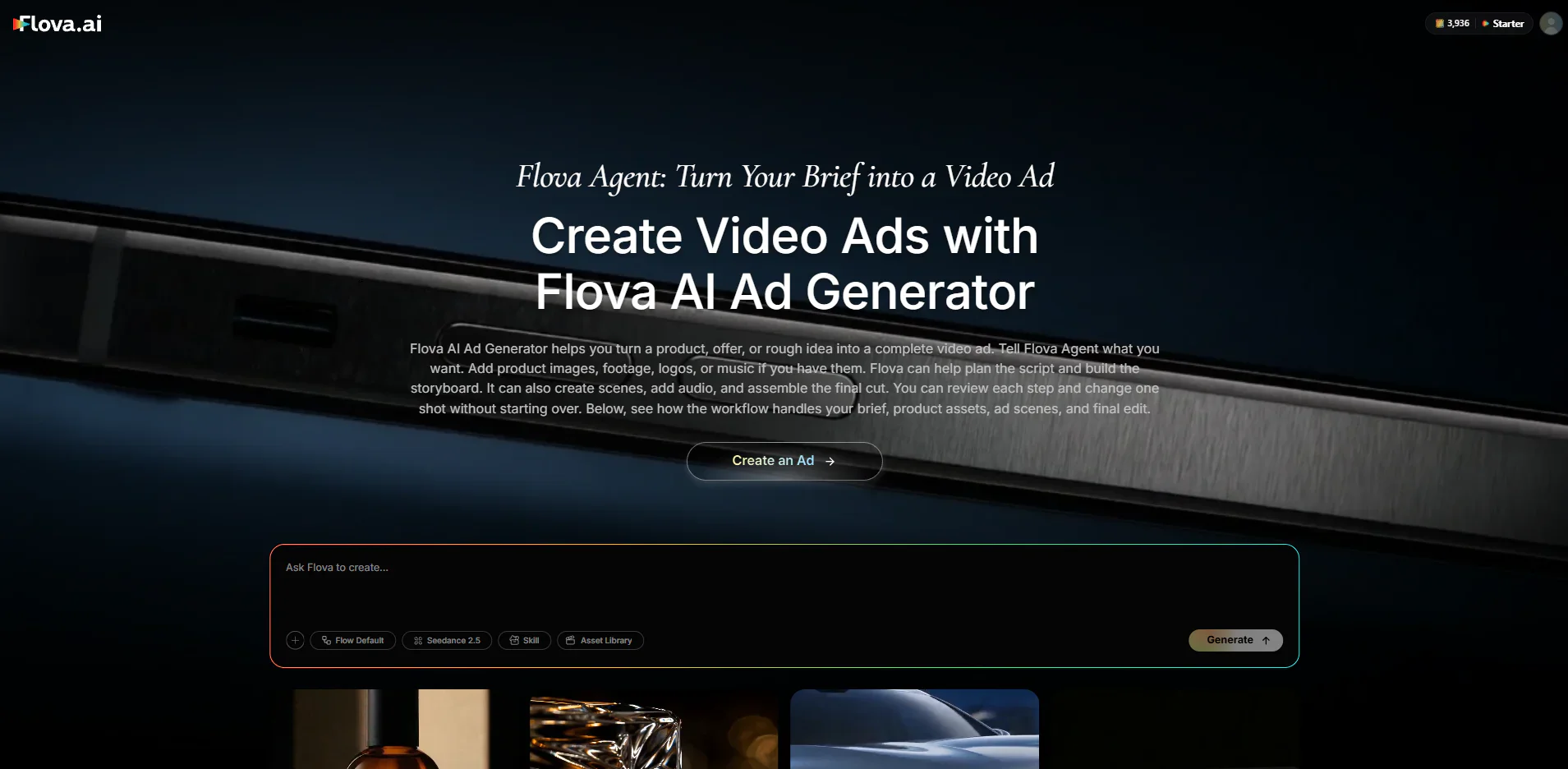
Creating an AI-generated video ad involves more than generating individual clips. Marketers need to develop a clear concept, organize visual scenes, maintain product accuracy, and assemble the final creative into a cohesive advertisement.
Flova AI supports this process through an integrated workflow that connects AI-assisted planning, storyboarding, media generation, and timeline editing within a single project workspace.
Here's how marketers can create a multi-shot product advertisement using Flova:
Step 1: Start with a Prompt or Product References
Begin by describing your advertising concept in natural language or uploading reference materials, such as product images. Specify the product, target audience, visual style, key message, and desired scenes.
For example, a skincare brand might start with:
"Create a 15-second skincare product advertisement featuring a product close-up, an application scene, and a final brand-focused shot. Use soft lighting, neutral colors, and a premium visual style."
Step 2: Develop the Storyboard
Flova's AI-assisted planning workflow can help organize the concept into a script, shot list, and editable storyboard.
Review each proposed scene to ensure the product presentation, visual direction, and advertising message align with the campaign brief.
Step 3: Generate Images and Video Assets
Generate visual assets for individual shots using the available image and video generation workflows. Product reference images can help guide the creative direction, while generated clips can be reviewed and refined before assembly.
Check product packaging, labels, colors, and claims against approved brand materials rather than assuming AI-generated details are accurate.
Step 4: Assemble and Edit the Video
Associate selected media with storyboard shots and arrange them in Flova's editing timeline.
Review the sequence, pacing, transitions, and overall narrative. Refine individual shots or replace assets where necessary to improve the final advertisement.
Step 5: Review and Export the Advertisement
Before exporting, verify the final video's product accuracy, brand consistency, commercial-use permissions, and advertising-platform requirements.
Confirm that the selected Flova subscription permits the intended commercial use and that all third-party assets and likenesses have appropriate permissions.
From Concept to Creative
By connecting planning, storyboarding, asset generation, and timeline assembly, Flova provides a structured workflow for developing multi-shot advertising videos within one project.
Explore how to create videos with Flova Agent or use the AI Ad Generator to turn a brief and approved asset into a planned, reviewable advertising workflow.
Image Generation
Midjourney, Adobe Firefly, and Stable Diffusion 3.5 document image-generation capabilities, although their controls and terms differ by product and model. These tools can generate visual concepts from text and reference inputs that teams may adapt as hero images, background plates, or product-context scenes after review.
Use clear, model-appropriate prompts and iterate on the result because the amount of useful detail varies by tool. A clear, approved reference asset and verified product or brand details are especially important when accuracy matters. Prompt detail is editorial guidance, not proof that a given prompt length will eliminate rework or ensure brand consistency.
Short-Form Video Generation
Short-video specifications are model-specific. For example, Runway Gen-4.5 lists clip durations of 2–10 seconds, while Kling 3.0 lists 3–15 seconds. Reference media can guide generation, but teams should review each clip for product accuracy, continuity, claims, permissions, and fit for the intended placement.
Variation and Localization at Scale
An approved master creative can be adapted into multiple localized or audience-segmented variants by changing copy, background scenes, or product colorways. Generate multiple versions and compare them; the available batch size depends on the tool, plan, and settings. A supported translation or dubbing workflow can create language versions. For example, Adobe Firefly Translate Video documents translation and dubbing under stated constraints. Each version should still be reviewed for language, cultural fit, claims, and brand accuracy.
Keeping Output On-Brand
Brand consistency is a material operational risk in generative creative. Teams can maintain approved visual and voice guidance, reference assets, and a human review process before final assembly and trafficking. Flova documents reusable Skills, editable prompt drafts, and comments. It also documents confirmation points in certain workflows, along with project documents and Asset Library reuse. These are provider-described features rather than a centrally governed brand-prompt library or formal media-buying review queue. Teams should retain their own approval process before publishing or trafficking an ad.
Prompt construction frameworks and a tool-by-tool capability comparison are covered in greater depth in the dedicated creative guide.
Benefits of Using AI in Advertising: Speed, Cost, Scale, and Personalization
AI-assisted workflows may improve creative iteration, reduce some production work, expand the number of versions teams can explore, and support more responsive ad delivery. The outcome is not automatic and should be measured against an appropriate baseline.
Faster Creative Iteration
AI can help teams produce early drafts of concepts, storyboards, images, and video shots. Flova's connected planning, storyboarding, generation, and editing workflow is relevant to this stage because teams can refine a multi-shot creative project in one workspace.
That describes a documented workflow, not a verified production-speed benchmark. Actual time saved depends on the brief, source materials, revisions, and approval process.
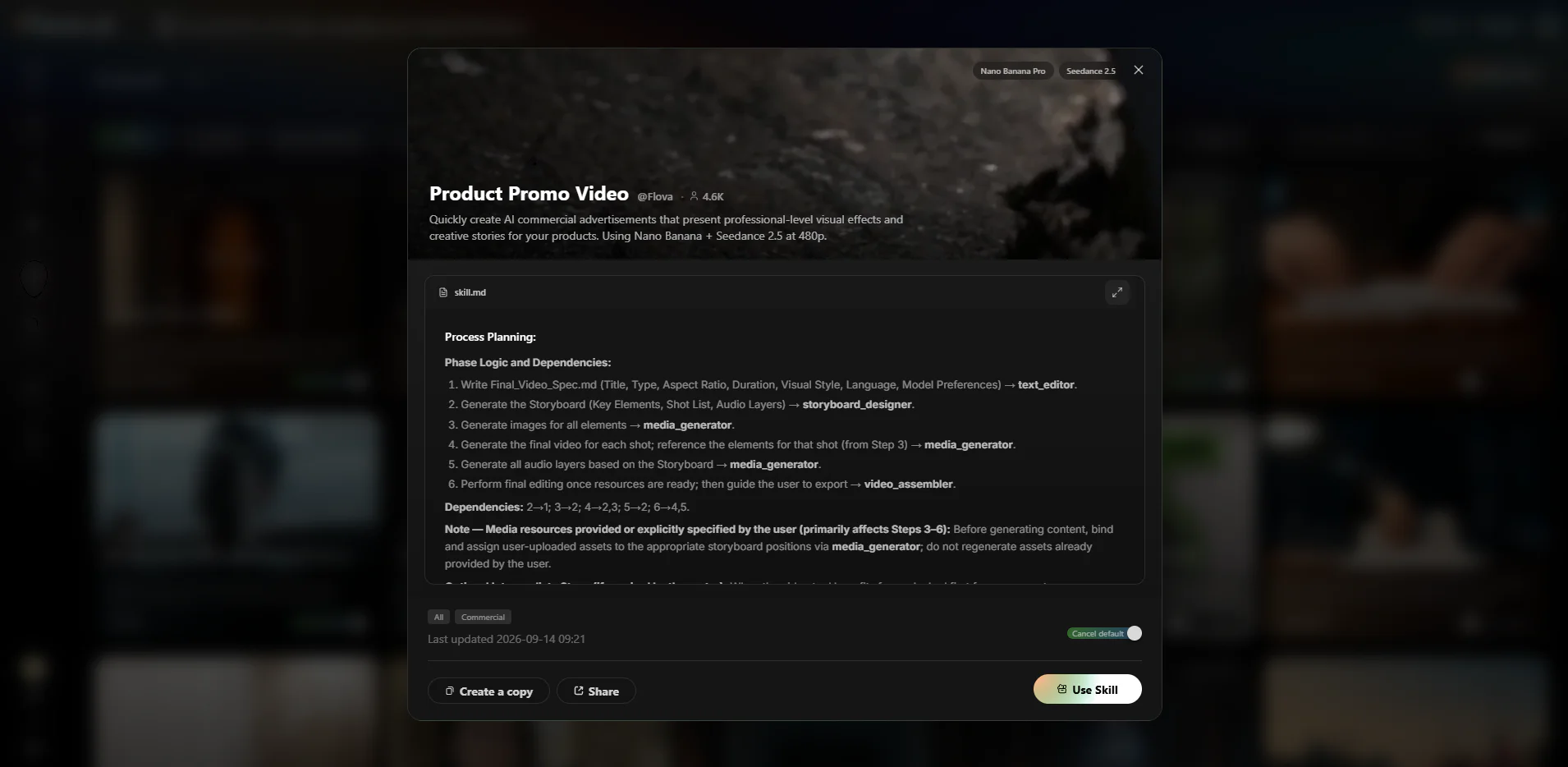
Reuse a Product Promo Video Skill Instead of Starting from Scratch
For repeatable product-ad creation, marketers do not always need to build a new creative workflow from an empty prompt. Flova AI offers a Product Promo Video Skill that can be copied and adapted for a product campaign. The Skill is associated with Nano Banana Pro and Seedance 2.5; available models and workflow behavior should be checked in the current Skill before use.
A practical way to try it is to find Product Promo Video in Flova's Skills collection, copy the Skill, and adapt its instructions and reference materials to your product. Supply approved product images and messaging, review the generated creative, and refine the result before publishing. Copying a Skill gives the team a reusable starting point; it does not guarantee consistent product details, faster production, or better advertising performance.
Image alt text: Flova AI Product Promo Video Skill using Nano Banana Pro and Seedance 2.5 for reusable product advertising workflows.
Image caption: Flova's Product Promo Video Skill offers a copyable starting point for developing product-focused video creative.
Want to try a reusable workflow? Browse Flova’s Skills collection and look for Product Promo Video. Review the current Skill’s models and instructions before copying and adapting it for your campaign.
Potential Production Cost Savings
Reusable inputs and workflows may reduce some setup effort for additional creative variations. However, generation is not free, and the cost of usable output includes failed attempts, human review, and editing.
Flova uses credits, with usage varying according to factors such as task type, model, duration, resolution, frame rate, reference mode, and other settings. Teams should estimate costs for the actual workflow rather than assuming a fixed price per completed ad.
McKinsey has estimated that generative AI could create productivity value equivalent to 5–15% of total marketing spending across relevant applications. This is a broad potential estimate, not a measured saving for Flova or for an individual campaign.
More Creative Variations
AI tools can make it easier to explore multiple approved concepts and versions. For example, a marketer could develop alternative openings or visual treatments for the same product advertisement, then choose which versions merit testing.
More variants are not automatically better. The number worth producing should follow the learning question, testing budget, and review capacity.
Personalization and Delivery Optimization
Advertising platforms can use approved creative components, data, and delivery rules to assemble or select variations for different contexts. Results depend on the platform configuration and data permissions.
Treat improved click-through rate, conversion rate, or return on ad spend as hypotheses to test—not guaranteed outcomes of using AI.
Risks and Limitations: Brand Trust, Hallucination, and “AI Slop”
AI can also produce inaccurate, generic, or off-brand creative. These risks call for accountable review rather than either blanket rejection or blind trust.
Hallucinated Claims and Product Details
Generative models can produce persuasive but incorrect claims, invented numbers, or inaccurate packaging. For example, an AI-written skincare ad might state that a product is “clinically proven” without any supporting study.
NIST identifies confidently stated false information—sometimes called confabulation or hallucination—as a generative-AI risk. Objective advertising claims should be substantiated before publication, consistent with applicable advertising standards such as FTC guidance.
Generic or Low-Quality Creative
“AI slop” is an informal term for content perceived as repetitive, low-quality, or carelessly generated. Its reception is subjective and should not be treated as a measured property of all AI content.
In a 2025 international survey, Ipsos reported mixed consumer attitudes toward the use of AI to create advertising images or video: 35% said it would make them trust companies and brands less, while 29% said it would make them trust them more. Those figures concern attitudes toward AI use, not a direct test of any particular advertisement.
Off-Brand Output
A generic prompt that contains only a product name and call to action may omit important brand details. Provide approved references and clear constraints, then review the output against the actual product and brand system.
For Flova projects, reusable creative materials and project organization can help teams maintain context across shots, but human review remains essential.
Backlash Against AI Commercials
Coca-Cola's AI-driven holiday advertising in late 2024 drew public criticism about visual artifacts and perceived lack of warmth. Reporting also described human creative contributors and production teams, so the campaign should not be characterized as raw, unreviewed AI output.
The lesson is not that AI-generated advertising inevitably fails. It is that brands should assess whether the creative works for the audience and whether the final execution meets their quality standards.
Frequently Asked Questions
How is AI actually used in advertising day to day?
AI can assist with day-to-day tasks such as drafting or adapting creative variants and analyzing performance data. Where an ad platform provides it, AI can also automate bids toward a selected conversion or value goal. Google Smart Bidding is one documented example of auction-time bid optimization. Teams should validate audience, creative, and measurement decisions rather than treat AI output as an automatic campaign decision.
What are the main benefits of using AI in advertising campaigns?
Potential benefits include faster early creative iteration, easier production or adaptation of variations, and platform-level bidding automation. Whether these improve cost, relevance, or campaign results depends on the brief, data, controls, and measurement. Flova describes a workflow for planning, generating, assembling, and refining video creative from prompts and reference media; this is a provider-described creative capability, not a campaign-performance claim.
What are the biggest risks and limitations of AI-generated ads?
Key risks include inaccurate or misleading generated material, harmful bias or homogenized output, and inadequate review of factual claims, rights, and context. NIST's generative-AI profile identifies confabulation, harmful bias or homogenization, privacy, and information-integrity concerns. Inspect the final asset and substantiate objective advertising claims before it runs.
Is it legal to use AI-generated images in commercial advertising?
Legality depends on jurisdiction and use, though AI-generated images may be usable in commercial advertising. Confirm the applicable tool and model terms, whether the plan permits commercial use, permissions for inputs and any depicted person, relevant intellectual-property and advertising rules, and current platform policies. For Flova outputs, commercial use requires a subscription plan that explicitly permits it, and the user remains responsible for the output's legality.
Do you have to disclose when an ad was created with AI?
Disclosure requirements vary by jurisdiction and platform. In the EU, Article 50 of the AI Act has applied since 2 August 2026. Providers must machine-mark certain generative-AI output, while professional deployers must clearly label deepfakes and certain AI-generated public-interest text. Meta and Google have separate disclosure rules for defined social-issue, election, or political content. Check local law and platform policy before launch, and consider clear disclosure where a realistic synthetic depiction could mislead.
How much does it cost to start using AI in advertising?
Expenses vary by vendor, plan, account, region, and how much is generated. At Flova, subscriptions and credits cover usage; charges vary by task type, model, duration, resolution, frame rate, reference mode, channel, and other settings.
Which types of AI matter most for advertisers — generative, predictive, or targeting?
These labels are a practical workflow guide, not a universal taxonomy. Generative AI can help create or adapt assets. Predictive or machine-learning models can estimate outcomes from available data, while platform-native targeting or bidding systems can automate delivery toward a selected objective. Start with the capability that fits the decision and validate performance — an effective campaign does not require all three.
Where can I see real examples of brands using AI in advertising?
Publicly documented examples include Coca-Cola's 2023 Create Real Magic platform, which combined GPT-4 and DALL-E and invited artists to submit work for possible billboard display; Heinz's A.I. Ketchup campaign; and Cadbury's Shah Rukh Khan My Ad, which WPP says used machine learning to create localized ads supporting more than 2,000 local businesses. They illustrate different uses of AI, not blanket proof of paid-ad performance or commercial clearance.