Key Takeaways
- AI in Advertising Examples are useful when they identify the method behind the ad. These seven campaigns show generative creative, simulation, and personalization—not seven comparable claims of commercial success.
- The cases explain what each team made and distinguish documented activity from brand- or agency-reported results.
- Nike and AKQA’s Never Done Evolving received the 2023 Cannes Lions Digital Craft Grand Prix in C04: Curation of Data for a simulation based on Serena Williams’ career evolution.
- Coca-Cola’s 2024 AI holiday films and the Toys“R”Us Sora film prompted documented online criticism and debate; the available reporting does not establish campaign failure or representative audience sentiment.
- Two recurring questions raised in criticism of these releases concern AI reinterpretations of emotionally familiar work and whether attention shifts from the creative to the production method.
- With Flova, you can turn an approved brief and asset set into a reviewed video-ad test; it is not presented here as a campaign winner or a performance ranking.
- Start with a campaign question, keep a control, and approve claims, rights, and final creative before publication.
At a Glance
A quick map of the seven documented campaigns. The eighth row is a next-step test, not an additional brand case.
Turn Campaign Lessons Into a Video-Ad Test With Flova
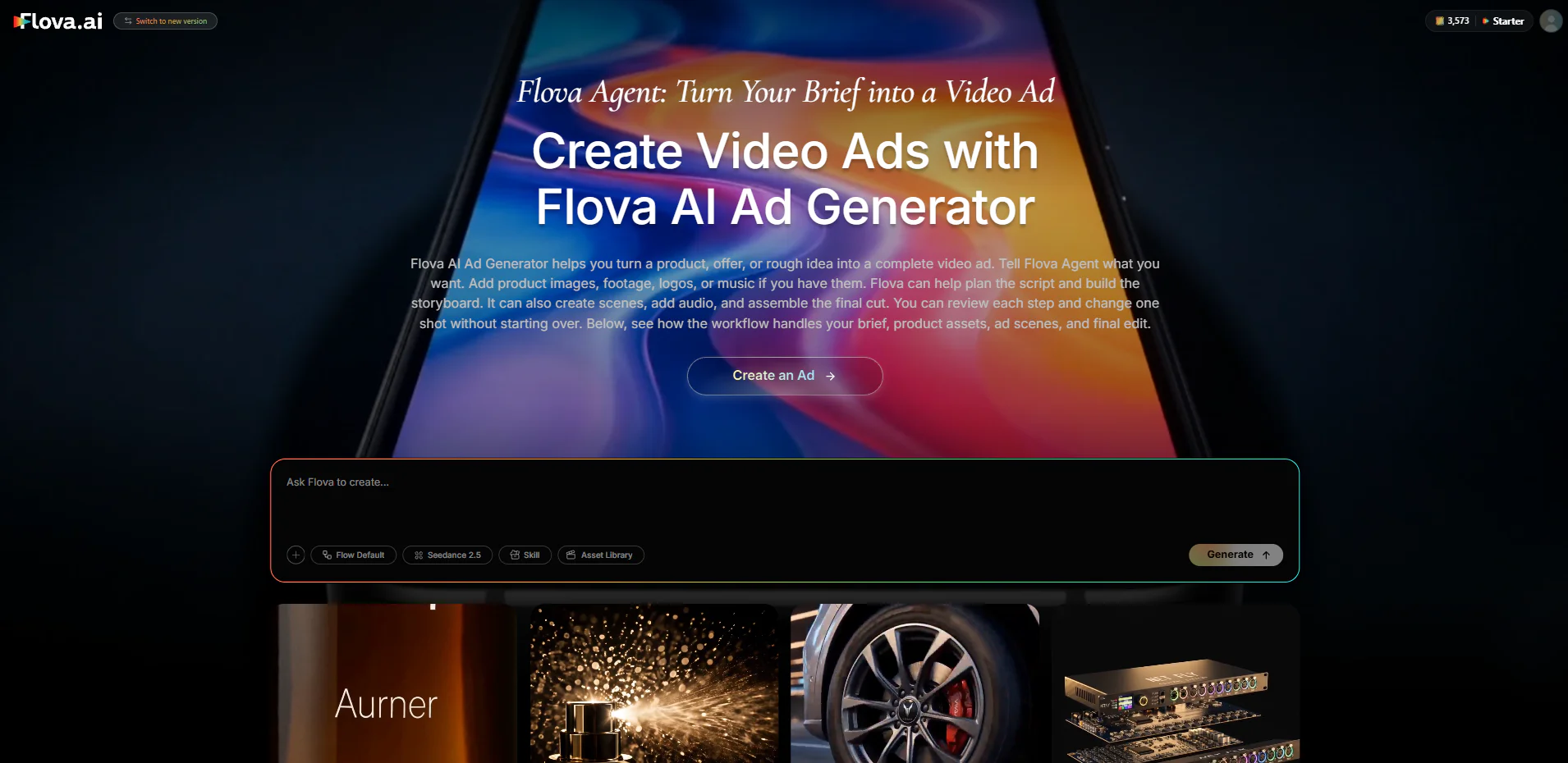
These campaign examples become useful when they lead to one focused test, not an attempt to recreate a global brand’s budget or media footprint. With Flova, you can turn one product offer and an approved asset pack into a video-ad workflow that your team can review before launch.
Flova is designed for the creative-production part of the test: turning a brief and approved references into a script, storyboard, scenes, audio, and a finished edit. For repeatable product promos or campaign variations, Flova Skills can package a workflow for planning, prompts, storyboards, media generation, and editing. Flova does not replace campaign strategy, rights review, media-buying judgment, or measurement.
Build the Test in One Connected Workflow
Start with a concise brief: the product, audience, offer, target channel, duration, and call to action. Add approved product images, footage, logos, music, or copy. Flova can help shape the concept, script, shot plan, and storyboard before full generation begins, so the team can check campaign logic before it becomes a finished ad.
Then create scenes and audio, assemble the edit, and revise an individual shot without rebuilding the whole project. Reuse the same product references across creative variations, while keeping a human reviewer responsible for packaging details, product claims, prices, end cards, rights, and the final call to action.
Keep the experiment narrow. Use one approved asset as the control, then make one Flova variation that changes a single creative decision—such as the opening hook, product demonstration, pacing, or story angle—while the offer, audience, landing page, and placement stay comparable. This gives the team a clearer basis for deciding whether to iterate.
What Counts as AI in Advertising? (Quick Definition)
AI in advertising uses machine learning or generative models to help make, tailor, place, or evaluate campaign work. The method should serve a defined marketing question.
For these examples, use one consistent five-part framework:
- Generative creative — producing or assembling visual, video, audio, or written assets.
- AI/ML-enabled simulation — modeling a scenario to express a campaign idea.
- Dynamic creative and personalization — varying messages by location or permitted user input.
- Audience or media optimization — using data-driven systems to inform delivery.
- Measurement, review, and governance — setting a control and approving claims, rights, and outputs.
- These layers can coexist. The primary AI role is identified in each case below.
A generated asset is not evidence of effectiveness. Results require a suitable comparison and clear attribution.
This distinction keeps the examples useful without equating a view count, an award, and a sales outcome.
Categories of AI Advertising Use Cases (How to Read These Examples)
The same five use-case categories apply throughout this article. Each describes a campaign decision, not a tool ranking.
- Generative creative — Coca-Cola, Heinz, and Toys“R”Us used models to create or assist brand assets.
- AI/ML-enabled simulation — Nike and AKQA modeled two Serena Williams career eras.
- Dynamic creative and personalization — Cadbury and Virgin Voyages tailored outputs to local or user-provided details.
- Audience or media optimization — delivery can use location or platform data; creative production alone does not prove targeting value.
- Measurement, review, and governance — every use case needs control, cleared assets, and human approval.
- Campaigns may combine categories, but added complexity does not itself show stronger outcomes.
Read each case for its documented method, evidence limit, and transferable creative decision.
How We Chose & Evaluated These AI Advertising Examples
The AI advertising examples in this article meet four selection criteria: a named brand, a clearly identified AI use case, public campaign documentation, and a campaign date sufficiently recent to illuminate current practices or an important historical precedent.
The tool descriptions are based on publicly documented product features, pricing, and access conditions rather than unpublished publisher testing. The workflow-fit observations are editorial assessments of the documented use cases, not independent benchmarks of creative quality, ease of use, or campaign performance.
Reported outcomes draw on brand releases, vendor or agency case-study pages, and trade-press coverage. A number appears only when a named public source carries it and is attributed where it comes from a brand or agency. This article does not conduct controlled measurements or extrapolate performance figures beyond the cited reporting.
Campaigns were excluded where the AI component was only unspecified marketing automation rather than a distinct creative, personalization, or media-buying system. Examples with no public documentation of the implementation were also excluded. The resulting cases identify discrete approaches that a marketing team may adapt, subject to its own approvals, data access, rights clearance, and measurement plan.
Real Brand AI Advertising Campaign Examples (What They Did & the Result)
These AI in Advertising Examples cover seven documented campaigns across six brand subsections. Coca-Cola appears twice because its 2023 creative platform and 2024 holiday films were distinct campaigns. Each case names the primary AI use, what the team did, what the available sources establish, and one practical lesson. Agency-reported reach is labeled as such. The examples are not a ranking and do not provide a common measure of return on investment.
Coca-Cola — ‘Create Real Magic’ & AI Holiday Ads
Coca-Cola used generative AI as the core creative engine in two distinct campaigns. The company launched Create Real Magic in March 2023, inviting digital creatives to generate original work with brand-provided archive elements, including the contour bottle, Spencerian-script logo, Santa, and Polar Bear. Coca-Cola said the platform, built for it by OpenAI and Bain & Company, combined GPT-4 and DALL·E; artists could submit work for the opportunity to be featured on Coca-Cola digital billboards in Times Square and Piccadilly Circus. The announcement supports an opportunity to be featured, not a confirmed placement or exposure total.
Coca-Cola’s 2024 holiday campaign paired a real-time, AI-powered conversation with Santa and shareable personalized digital snow globes with three AI-driven reimaginings of its 1995 Holidays Are Coming film. Coca-Cola identified Secret Level, The Wild Card, and Silverside AI as production houses and described human storytellers, artists, and a live choir alongside generative AI. It also said a North American geo-specific media buy could tailor film elements locally. The films drew documented online criticism from some creatives and social-media users, as NBC News reported; that reporting does not establish a uniform public response or business outcome. Editorial takeaway: the 2023 work illustrates participatory use of brand-provided assets, while the 2024 reaction shows why familiar brand heritage and production disclosure merit careful review.
Heinz — ‘A.I. Ketchup’
In July 2022, Heinz and agency Rethink used OpenAI’s DALL·E 2 to turn prompts such as “ketchup,” “impressionist painting of a ketchup bottle,” and “Ketchup in Space” into images. Many of the displayed outputs echoed Heinz bottle or label cues, which Heinz used to extend its “Draw Ketchup” idea. The launch combined a video, Twitter and Instagram content, and an out-of-home activation in downtown Toronto; fans were invited to suggest additional prompts. Contemporary coverage described Heinz as among the early brands to use DALL·E 2 in marketing, rather than as the definitive first major brand to use AI in advertising.
Rethink later reported more than 1.15 billion earned impressions worldwide in a case study, while an earlier Rethink/Kraft Heinz award entry reported more than 850 million; the available sources do not provide an independent audit or reconciled methodology. The campaign’s concept should therefore be read as brand framing and selected creative output, not proof that the model “preferred” Heinz or produced its branding every time. Editorial takeaway: a constrained prompt experiment can make a clear brand-recognition idea legible across video, social, and out-of-home formats.
Nike — ‘Never Done Evolving’ (Serena Williams)
Nike and AKQA released Never Done Evolving in August 2022 as part of Nike’s 50th-anniversary work, using AI and machine learning to turn Serena Williams’ career evolution into a virtual match. AKQA says the models represented her 1999 U.S. Open and 2017 Australian Open eras — 17-year-old versus 35-year-old Serena — with era-specific decisions, shot selection, reactions, recovery, and agility modelled from archival footage. Accompanying project accounts say official-tournament data and footage informed the study.
The work was a simulation, not a real or scientifically validated head-to-head. It won the 2023 Cannes Lions Digital Craft Grand Prix in C04: Curation of Data, as well as a Silver Lion for Innovative Use of Technology. Editorial takeaway: the case uses a documented sports narrative to visualize evolution over time, rather than presenting the simulated result as a real-world prediction.
Cadbury — Personalized Shah Rukh Khan Ads
Cadbury Celebrations’ Shah Rukh Khan-My-Ad was the Diwali 2021 update to its 2020 “Not Just A Cadbury Ad” initiative. Using machine learning and dynamic creative optimization, the campaign created geo-targeted ads in which a digital avatar of Shah Rukh Khan named nearby local shops. During the campaign, a microsite let retailers — and, according to the launch announcement, consumers — create downloadable, shareable versions for a chosen local business. WPP’s case study documents that implementation.
WPP reported 130,000 ads featuring 2,000 stores and 94 million YouTube and Facebook views; these are WPP-reported campaign figures. The work later won the 2023 Cannes Lions Creative Effectiveness Grand Prix. Editorial takeaway: it is a documented example of localized dynamic creative, but the sources do not show that every Indian local business received paid-media distribution or that the campaign made a separately produced video for every viewer.
Virgin Voyages — AI Jennifer Lopez Invites
Virgin Voyages introduced Jen A.I. in June 2023, a limited-time web experience that generated personalized Jennifer Lopez digital-twin video invitations. Users supplied details about a celebration, destination, and guests, including names; the completed invitation was emailed to the user to share with friends and family. Lopez participated in the campaign and gave Virgin Voyages permission to use her likeness; the reviewed public sources do not disclose the terms of any license agreement.
Built with generative voice and video, Jen A.I. tailored a digital-twin invitation to user-supplied celebration and travel details. The campaign team said it used guardrails and filters for inappropriate or offensive content. VML, Virgin Voyages’ agency, later reported more than 25,000 personalized invites, close to 200,000 microsite interactions, and over two billion impressions; these are agency-reported, unaudited results. Editorial takeaway: the case demonstrates consent-based celebrity personalization with documented safeguards, not proof of automatic recipient delivery, viral sharing, or booking causality.
Toys“R”Us — Sora-Generated Brand Film
In June 2024, Toys“R”Us Studios and Native Foreign premiered a 66-second brand film at Cannes Lions that was made almost entirely with OpenAI’s Sora, which was then available to the agency through early access. Toys“R”Us said corrective VFX and an original score were also used. The film imagines a young Charles Lazarus in his family’s bicycle-shop setting, dreaming of a future toy store and an encounter with Geoffrey the Giraffe; it is an imagined brand-origin story, not proof of the mascot’s literal origin.
Toys“R”Us called it the first brand film made with Sora. Contemporary coverage more cautiously described it as believed to be the first Sora-made ad, while other reporting called it one of the first from a major brand. Online reaction was mixed and contentious: some observers praised text-to-video’s apparent potential, while critics questioned the work’s look and generative AI’s implications for creative jobs. Editorial takeaway: pioneering tool use can make the method itself a major part of the public conversation; the available coverage does not demonstrate a universal audience response or campaign-performance result.
The Backlash Cases: When AI Ads Went Wrong
The Coca-Cola 2024 holiday reimaginings and the Toys“R”Us Sora film are better described as documented backlash cases, not proven net-negative campaigns. Coca-Cola’s holiday video drew online criticism from some creative professionals and social-media users, while The Hollywood Reporter characterized reaction to the Toys“R”Us film as mixed. The available reporting does not establish a representative audience view, a causal business effect, or a campaign failure for either work.
Two recurring issues are visible in the coverage. First, AI reinterpretations of emotionally resonant existing work can invite scrutiny over the new work’s look and feel. Second, prominently discussing a generative production method can shift attention from the brand story to questions about creative labor and process. These are considerations for creative and approval teams, not evidence that the tools themselves determine outcomes.
AI Ad Lessons: Creative Fit, Risks, and Review
A clear brief and cleared assets matter more than the novelty of the production method. Keep human approval for final creative and each scaled variant.
Coca-Cola’s 2024 holiday reimagining drew online criticism in late 2024, particularly from some creatives and social-media users, as NBC News reported. The reporting captures visible criticism, not representative consumer sentiment, a finding that the campaign failed, or a causal business result.
The useful lessons are practical:
- Check disclosure and provenance requirements for the destination market and channel.
- Review claims, brand safety, asset rights, likeness consent, and the final export.
- Protect brand cues with approved inputs and a documented review standard.
Outcomes depend on the brief, execution, distribution, and measurement design—not AI use alone.
How to Replicate These AI Advertising Examples in Your Own Campaigns
The useful way to apply AI in Advertising Examples is to test one transferable decision, not to imitate a famous campaign’s scale. A team without celebrity talent or archival assets can still compare one AI-assisted creative with an approved control. Keep the campaign question, offer, audience, approved assets, and human reviewer visible throughout. Record the version that actually runs so the result can be connected to a specific asset.
1. Choose One Use-Case Category
Choose one primary use case from the five-part framework above and define the business question it should answer.
2. Build the Creative Test With Flova
For a video-ad hypothesis, use Flova to turn an approved brief into a reviewed creative workflow. Define the product, audience, offer, channel, duration, and call to action; add approved references; review the script and storyboard; then generate, revise individual scenes, and export only after a final check.
3. Produce One Controlled Creative or Automate One Buying Rule
Create one AI-assisted challenger against an approved control. Keep the audience, offer, landing page, and placement as comparable as possible.
4. Measure Against a Pre-Set Control
Set a primary metric and date range before launch. Do not claim incremental lift from views, publicity, or an uncontrolled comparison.
5. Apply Human Review Before Any Ad Goes Live
A named reviewer should check claims, rights, consent, brand safety, disclosure, privacy, and the rendered final asset before publication.
Frequently Asked Questions
What are some real examples of AI used in advertising?
Brands have used AI in advertising for creative generation and personalization. Coca-Cola launched Create Real Magic in 2023, inviting digital creatives to generate work using GPT-4, DALL·E, and brand-provided archive elements. Heinz and Rethink used DALL·E 2 for its 2022 “A.I. Ketchup” prompt experiment, in which many displayed outputs echoed Heinz bottle or label cues. Nike and AKQA used AI and machine learning for a virtual match representing two Serena Williams career eras; it was a simulation, not a recreation of archival footage or a validated athletic test.
Which companies appear in these AI advertising examples?
The developed cases here are Coca-Cola, Heinz, Nike, Cadbury, Virgin Voyages, and Toys“R”Us. They span different years; this is not a current-year campaign census.
What are the best AI advertising campaigns so far?
There is no verified, objective ranking of the “best” AI advertising campaigns. Heinz’s “A.I. Ketchup” and Coca-Cola’s “Create Real Magic” are well-documented examples that have received substantial trade-press attention: Adweek described Heinz as among the early brands to use DALL·E 2 in marketing, and Coca-Cola documented the participatory Create Real Magic platform. Campaign quality and effectiveness should be evaluated against a defined goal, audience, distribution plan, and measurement method rather than novelty or earned-media claims alone.
Have any AI ads faced backlash, and what went wrong?
In this article, the relevant criticism concerns the Coca-Cola 2024 holiday films and the Toys“R”Us Sora film. Public debate does not prove representative sentiment or campaign failure. The operational response is to review brand fit, rights, and the final message before release.
What AI tools do brands use to create these advertising campaigns?
Campaign teams may combine tools for generated assets, personalization, and media operations. For a video-ad creative test, Flova can take an approved brief and reference assets through scripting, storyboarding, scene creation, and a reviewed edit. Choose a workflow for the campaign question, not because a platform is presented as objectively best.
Are AI-generated commercials appearing on TV?
AI-assisted films can run across television, streaming, social, digital, or cinema, but the channel must be verified for each specific campaign. Distribution should not be inferred from a brand-film release.
How can a small business start using AI in its own ad campaigns?
Start with one offer and one approved control ad. With Flova, you can turn the brief and approved assets into a storyboard-led video-ad challenger, review product details and the call to action, and revise individual shots before export. Run it to a defined audience against a comparable control and measure a preselected outcome.